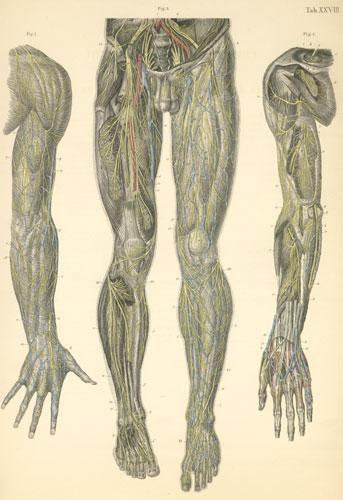
The body extremities are external articulated organs which carry out different locomotive functions. Humans have four extremities, also known as limbs. On the upper side, there are the arms and the lower extremities are the two legs. In the following article on what are the extremities of the human body, we explain their functions and components in detail.
Upper extremities: arms
The upper extremities of the human body are arms, which are connected to the upper torso and perform the function of providing mobility to catch, hold, and handle objects, enabling various activities. The limbs are composed of four parts which are easily distinguished:
- Hand
- Forearm
- Arm
- Shoulder girdle
The upper limbs are attached to the torso and are comprised of two clavicles and two scapulae. Within the arms, we find the humerus, radius, and ulna bones, while in the hands we find the carpals, metacarpals, and phalanges of the fingers. These components work together to perform intricate tasks like writing or playing musical instruments, showcasing the complexity and versatility of human hands.
Moreover, the shoulder girdle plays a crucial role in providing stability and range of motion, allowing the arms to perform a wide array of movements. This flexibility is essential for everyday tasks as well as athletic endeavors. Understanding the anatomy of the upper extremities can help in appreciating how these structures contribute to our daily functioning.

Lower extremities: legs
The lower extremities of the human body are legs, which are attached to the torso at the pelvis through the hip joint. Their functions include supporting the weight of the entire body and enabling us to walk, run, jump, and ultimately move to any point. The lower limbs are formed by the following parts:
- Thigh
- Leg
- Foot
- Pelvic girdle
The main bones in the lower limb of the human body are the femur, tibia, and fibula, along with the tarsus and metatarsus bones of the foot and the phalanges of the toes. The strength and structure of these bones allow for powerful movements, such as sprinting or jumping, which are critical for various physical activities.
In addition to bone structure, the musculature and tendons in the legs are vital for movement and balance. Muscles like the quadriceps, hamstrings, and calf muscles work in unison to provide stability and propulsion, making it possible to perform a wide range of motions. Furthermore, the pelvic girdle serves as a foundation, connecting the legs to the spine and supporting the body's core.
Understanding the anatomy of the lower extremities highlights their importance in not only movement but also in maintaining posture and balance. These functions are essential for both everyday activities and athletic performance, demonstrating the intricate engineering of the human body.

If you want to read similar articles to What Are the Body Extremities, we recommend you visit our Learning category.