Decimal Division Without a Calculator Step-by-Step With Examples


 Add us on Google
Doing decimal divisions without a calculator may seem difficult, but there is an easy method which we are going to show you. The trick is simply to remove the decimal point in the division and then replace the decimal point when you get to the answer.
Although it may seem very complicated at first glance, the fact is that this little trick makes it quite easy. So keep reading as we explain our method step-by-step with a few examples and discover how to do divisions with decimals without using a calculator.
Dividing a Decimal by a Whole Number
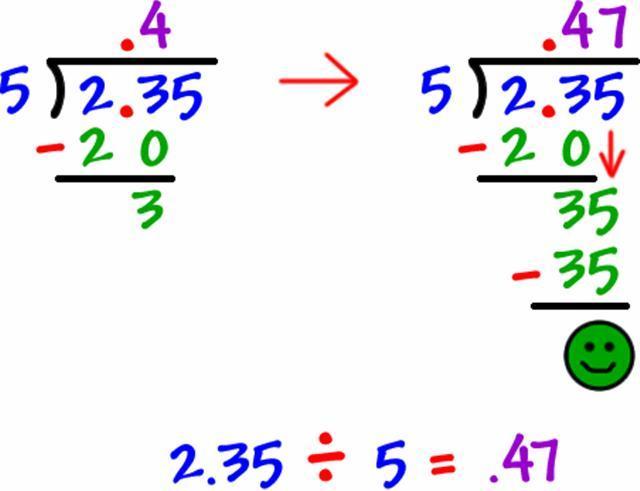
Use a normal division method, ignoring the decimal point. Then put the decimal point in the same place once you have obtained the divided figure. Look at the example below:
- 9.1 divided by 7
You remove the decimal point in 9.1 and the division is now: 91 ÷ 7
This makes the division much easier to calculate - the result is 13.
Remember for the last step, you have to reinsert the decimal point into this result. 13 is now 1.3 - yes, it's as easy as that!
It's important to understand why this method works. By removing the decimal, you simplify the numbers, making mental calculations more manageable. Once you reintroduce the decimal, you bring back the original scale of the number, ensuring accuracy in your result.
How to Divide by a Decimal Number
But why are you going to divide a decimal number?
The method this time is to convert the numbers you are dividing into a whole number. This exercise is solved by moving the decimal point of both numbers to the right. Example:
- 6.625 divided by 0.53
Move the decimal point two spaces, or the amount of space required to make it become an integer.
Now you are dividing by an integer and you can continue as normal: 662.5 ÷ 53
This is a very straightforward method but you must remember to move the decimal point by the same amount in both numbers.
Here is another example:
- 5.39 divided by 1.1
At the moment you are not dividing by an integer, so you need to move the decimal point. Move a single space and you now have: 53.9 ÷ 11
The rest of the division is easy because, as you learned at the beginning of this maths class, to divide a decimal number by a whole number you just need to forget about the decimal point for the first step and then put it back to get the final result. Continuing the example:
53.9 ÷ 11
539 ÷ 11
049
The result is 4.9!
In this regard, understanding how to manage decimal points is crucial not only for manual calculations but also for developing a deeper comprehension of numerical relationships. Ensuring that you handle decimals correctly can help in various real-world applications, from financial calculations to scientific measurements.
So there you go, above you have the easiest way to divide decimals without a calculator. This method not only simplifies the process but also reinforces your basic arithmetic skills, making you more adept at handling numbers in different situations.
If you want to read similar articles to Decimal Division Without a Calculator Step-by-Step With Examples, we recommend you visit our Learning category.