How To Convert Improper Fractions To Mixed Numbers


An improper fraction has a top number (or numerator) which is larger than the bottom number (or denominator). Fractions typically represent parts of a whole, but improper fractions represent an amount greater than the whole. This can be misleading and needs further explanation. In this OneHowTo article we explain how to convert improper fractions to mixed numbers or a mixed fraction to get a figure better demonstrating the amount it represents.
Steps to follow:
First, it's very important to know what proper fractions, improper fractions, and mixed fractions are. To do this, you should try to remember that the "numerator" is the number that appears on top of the fraction and the "denominator" is the one below. So:
- Proper fraction: the numerator is smaller than the denominator
- Improper fraction: the numerator is greater than or equal to the denominator
- Mixed number: a number accompanied by a proper fraction
Understanding these basics helps in recognizing why improper fractions can sometimes be less intuitive and why converting them into mixed numbers, which combine whole numbers with fractions, can be more useful for practical applications such as measuring, cooking, or even dividing resources.

Bear in mind that all improper fractions can be expressed with an equivalent mixed fraction and this conversion is exactly what we will be talking about in this OneHowTo article.
So, let's take a look at an example to make it easier to understand how to convert improper fractions to mixed numbers. Let's say you want to convert the improper fraction 9/4 into a mixed number.
By converting 9/4, you’ll be able to express this fraction in a form that indicates clearly the number of whole parts and the additional fractional part, making it easier to visualize and use in real-world scenarios.
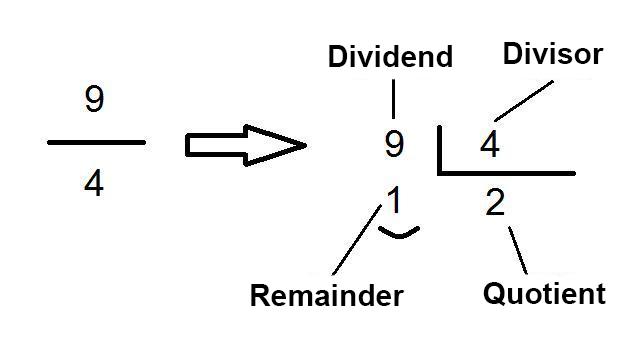
The first thing you do is divide the numerator (the top number, the larger number) by the denominator (the bottom number, the smaller number). In our example we have to divide 9 by 4.
With the sum worked out, you should note down the quotient and remainder of the division. This is key to forming the mixed fraction.
It should be noted that understanding this division process is crucial as it forms the basis of converting back and forth between improper fractions and mixed numbers, which can be valuable for various mathematical computations and problem-solving tasks.

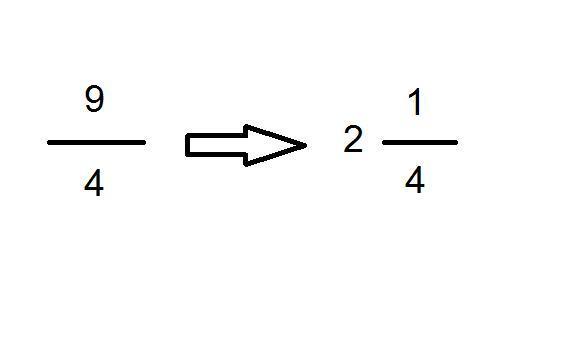
You should end up with a mixed fraction, followed by a fraction that is formed by the remainder of the dividing number (the original denominator). So, in the example, in the results of our sums with the mixed fraction, we can see that the integer will be 2 (the quotient of the division) and the fraction 1/4 (the leftover bits from our calculation):
9/4 = 2 1/4
In this regard, converting the improper fraction to a mixed number allows you to see that 9/4 is essentially two whole parts and an additional quarter, which can be particularly beneficial when dealing with tasks that require precise measurements, such as in construction or culinary arts.

If you want to reverse the sum, i.e. you want to convert a mixed number into an improper fraction, keep the denominator and then multiply the mixed fraction's whole number by the denominator. Afterwards, add the numerator to get the numerator of the improper fraction.
So, in the example, 4 is the denominator. You multiply 2 by 4 and you will add 1. That means that the improper fraction will be 9/4.
Similarly, converting a mixed number back into an improper fraction is useful for performing operations such as addition or subtraction of fractions, where having a common denominator is necessary for accurate calculation. This skill is also beneficial in algebra where improper fractions are often preferred for simplifying expressions.

If you want to read similar articles to How To Convert Improper Fractions To Mixed Numbers, we recommend you visit our Learning category.