What's the Difference Between Circle and Circumference?


Circle and circumference are two geometrical terms that often get confused and create doubts when you have to use them. Although you might think they are synonyms, they are not. Don't worry: here at oneHOWTO, we'll show you what is the difference between circle and circumference.
Steps to follow:
According to Merriam-Webster's Dictionary, a circle is ‘a perfectly round shape: a line that is curved so that its ends meet and every point on the line is the same distance from the center’.
The concept of a circle is fundamental in geometry and serves as the basis for understanding various mathematical principles. A circle is not just a shape, but also a fundamental element in equations and theories that describe circular motion and periodic functions in advanced mathematics.
A circumference, on the other hand, is ‘the length of a line that goes around something or that makes a circle or other round shape’.
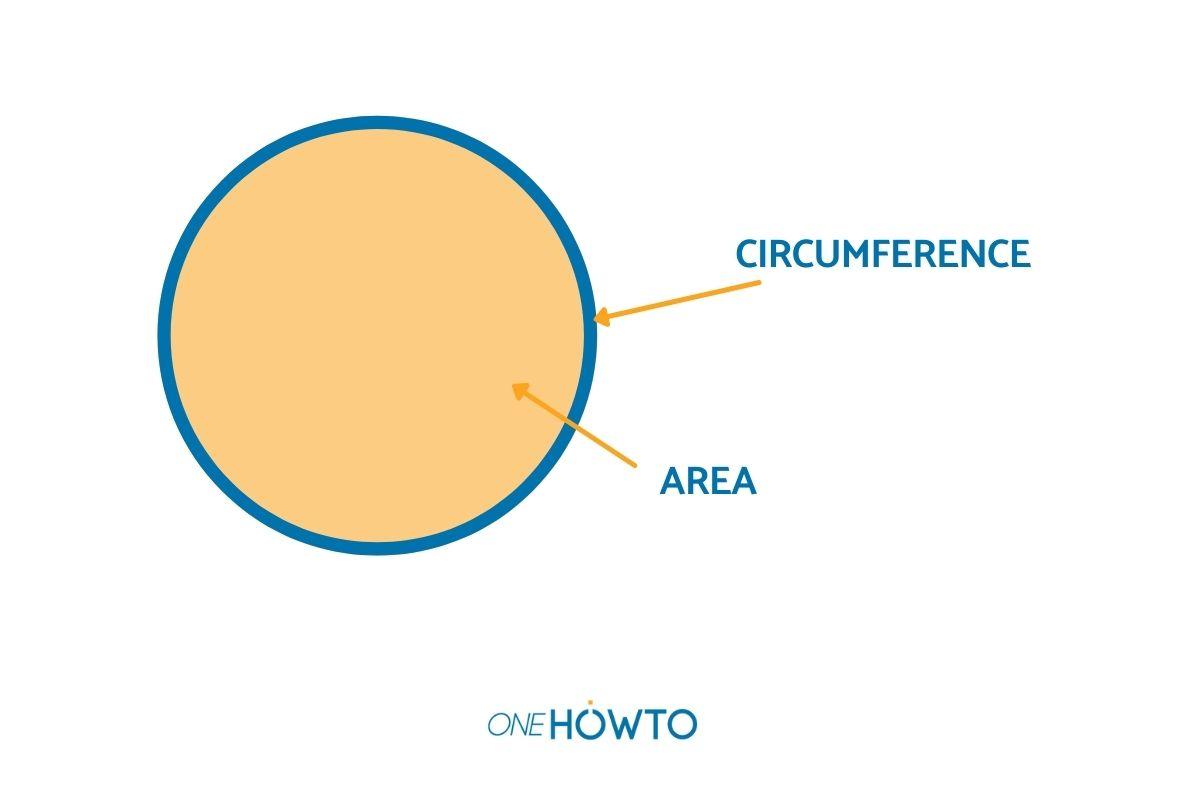
So, what is the difference between circle and circumference? When we use the word circle, we refer to the familiar round shape. When we say circumference, we are speaking of the length of the perimeter line of a circle.
It's important to understand that while the circumference is a measure of length, the circle represents a two-dimensional shape with an area. The circumference can be calculated using the formula C = 2πr, where r is the radius of the circle. This distinction is crucial when solving geometric problems or working with circular designs.
So you can understand, in the image you can see below, the circumference is the exterior line which is painted in blue, while the inner part which is painted in yellow is the area of the circle.
This visual representation helps in distinguishing between the two concepts. The area of the circle, represented by the yellow part, can be calculated using the formula A = πr², emphasizing its role as a surface measure.

For related article on geometry and shapes, take a look at our articles on how to calculate the volume of a cube and how to find the height of an oblique triangle using area.
Understanding these fundamental differences and calculations is essential not only for academic purposes but also for practical applications in fields such as engineering, architecture, and even art. These principles are applied in creating designs, understanding physical phenomena, and developing technologies.
If you want to read similar articles to What's the Difference Between Circle and Circumference?, we recommend you visit our Learning category.